Wed, April 16, 2014
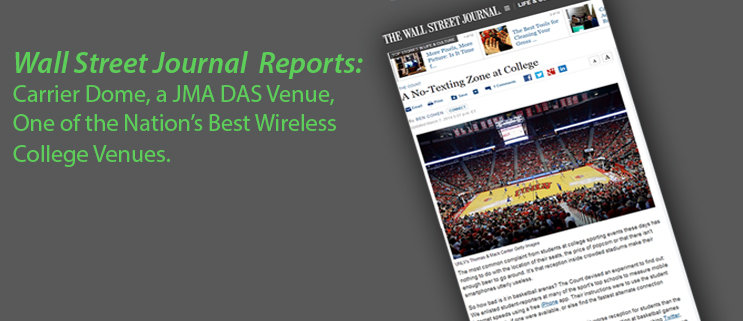
A No-Texting Zone at College
Story By BEN COHEN – Wall Street Journal
Updated March 7, 2014 5:57 p.m. ET
The most common complaint from students at college sporting events these days has nothing to do with the location of their seats, the price of popcorn or that there isn't enough beer to go around. It's that reception inside crowded stadiums make their smartphones utterly useless.
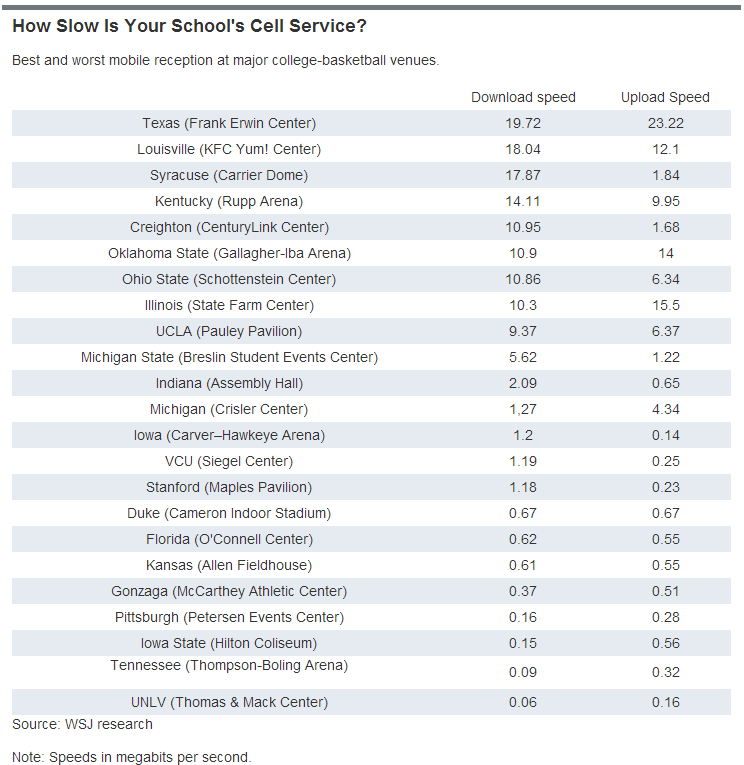
So how bad is it in basketball arenas? The Count devised an experiment to find out: We enlisted student-reporters at many of the sport's top schools to measure mobile Internet speeds using a free iPhone app. Their instructions were to use the student Wi-Fi network, if one were available, or else find the fastest alternate connection possible.
It turns out crowded basketball venues result in worse reception for students than the average smartphone speed in the U.S. Students say reception at basketball games isn't as lousy as it is at football games—yet it's weak enough that refreshingTwitter, uploading a photo to Instagram or checking email is difficult. "When we had slower devices, we were more willing and more patient," said Jamie Steven of Ookla, which operates the speed-test app our sleuths used.
The bottom spot in our 23-team poll belonged to UNLV's Thomas & Mack Center, where download speeds crawl at 0.06 megabits per second, slower than the 0.5 mbps the Federal Communications Commission recommends for basic web browsing. During crowded events like basketball games, "cell phone Internet speeds suffer," the arena's information-technology director Kurt Hoff wrote in an email. But the school is planning to install a distributed-antenna system it hopes will improve 3G and 4G cell coverage and is exploring Wi-Fi systems designed to handle high-density events.
"We will get there," he said, "and we will do it right."
Write to Ben Cohen at [email protected]